
Market Commentary
June 30, 2026
Q2 2026: Outwardly, the market remains dynamic—but some underlying factors are worth heeding
An unusually dynamic market defined this past quarter. Stocks continued to rise but, under the surface, leadership remained exceptionally narrow.
On a personal note, it was also a meaningful quarter for me and my family, as we welcomed our new daughter, Eliana. Moments like these have a way of reinforcing what matters most. And, in a way, they mirror investing: a long-term journey where patience, resilience, and perspective matter far more than short-term noise.
This lens is helpful when thinking about what we’re currently seeing in markets.
While, as noted, headline market performance has remained strong, a more nuanced story underlies that strength. Leadership has remained highly concentrated, with a relatively small group of companies, primarily those tied to artificial intelligence (AI), driving the bulk of returns.
This trend not only persisted over the past quarter but, in many ways, became more pronounced. What stands out is how strongly markets have rewarded price momentum, particularly within AI-linked businesses. Momentum-driven returns are off to one of their strongest starts in decades, despite periods of elevated volatility. At the same time, areas of the market tied more closely to improving company fundamentals, such as earnings revisions and profitability trends, have generally struggled to gain traction.
The divergence between these two forces is illustrated in the accompanying chart. Price momentum has been exceptionally strong, while fundamental momentum has remained comparatively subdued. In other words, markets have continued to reward what has already been working—particularly AI-related themes—while paying less attention to incremental improvements across the broader opportunity set.
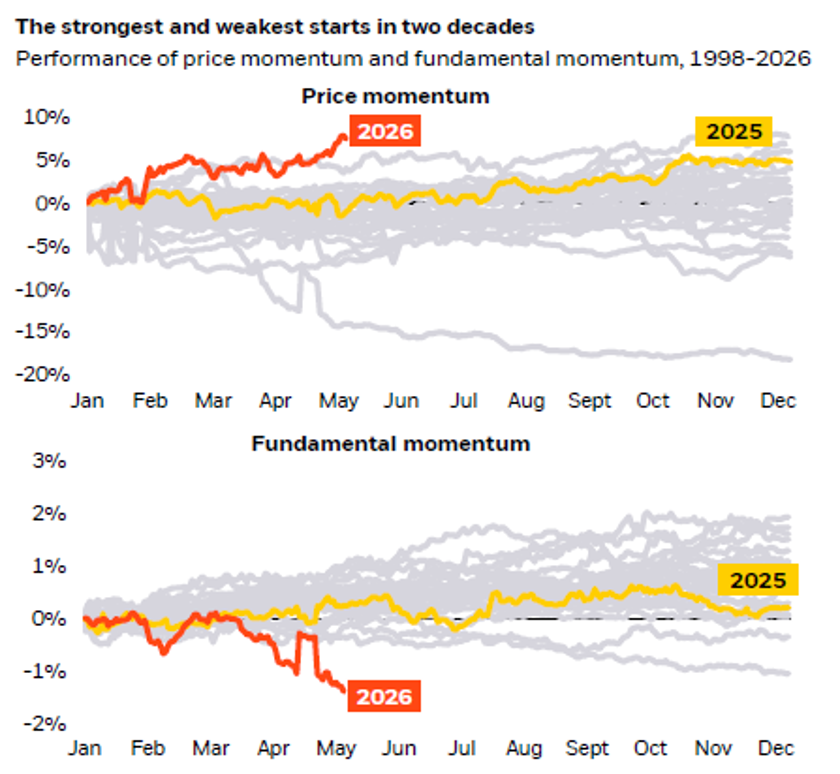
A key driver has been continued optimism around AI, particularly in areas tied to the physical infrastructure layer, such as semiconductors, data centres, and computer capacity. These segments have benefitted from both strong-earnings visibility and significant capital inflows. By contrast, more asset-light technology companies, along with many cyclical sectors, have lagged as investors weigh disruption risks and a still-uncertain macroeconomic backdrop.
The result is the current market, appearing strong at the index level but remaining uneven beneath the surface. This level of concentration is not unprecedented, but it does create a different kind of environment—one where outcomes are increasingly dependent on a narrower set of drivers, and where differentiation based on company-specific fundamentals has become more limited in the near term. (Source: BlackRock, 2025.)
Now, narrow leadership is not necessarily a signal that markets are about to reverse. But such leadership does change the risk profile. When performance becomes concentrated, outcomes become more dependent on a smaller group of companies, and expectations for those companies tend to rise.
Over time, more durable market advances tend to broaden out, with leadership rotating into other sectors and areas.
In this environment, our focus at Louisbourg remains on maintaining balance and discipline. While it is important to participate in areas of strength, we also place a strong emphasis on diversification and valuation.
Such periods can tempt investors to concentrate portfolios in what has been working most recently. However, history has shown that maintaining a broader opportunity set tends to lead to more consistent outcomes over time.
Looking ahead, the key question will be whether market leadership begins to broaden, or the current concentration persists. Either outcome is manageable, but both reinforce the importance of staying grounded in long-term fundamentals rather than short-term narratives.
As I think about both markets and life more broadly this quarter, one theme stands out: Long-term thinking matters. Whether raising a family or managing capital, consistency, patience, and discipline matter far more than reacting to every short-term development.
It’s a perspective I’m especially grateful for this quarter.